
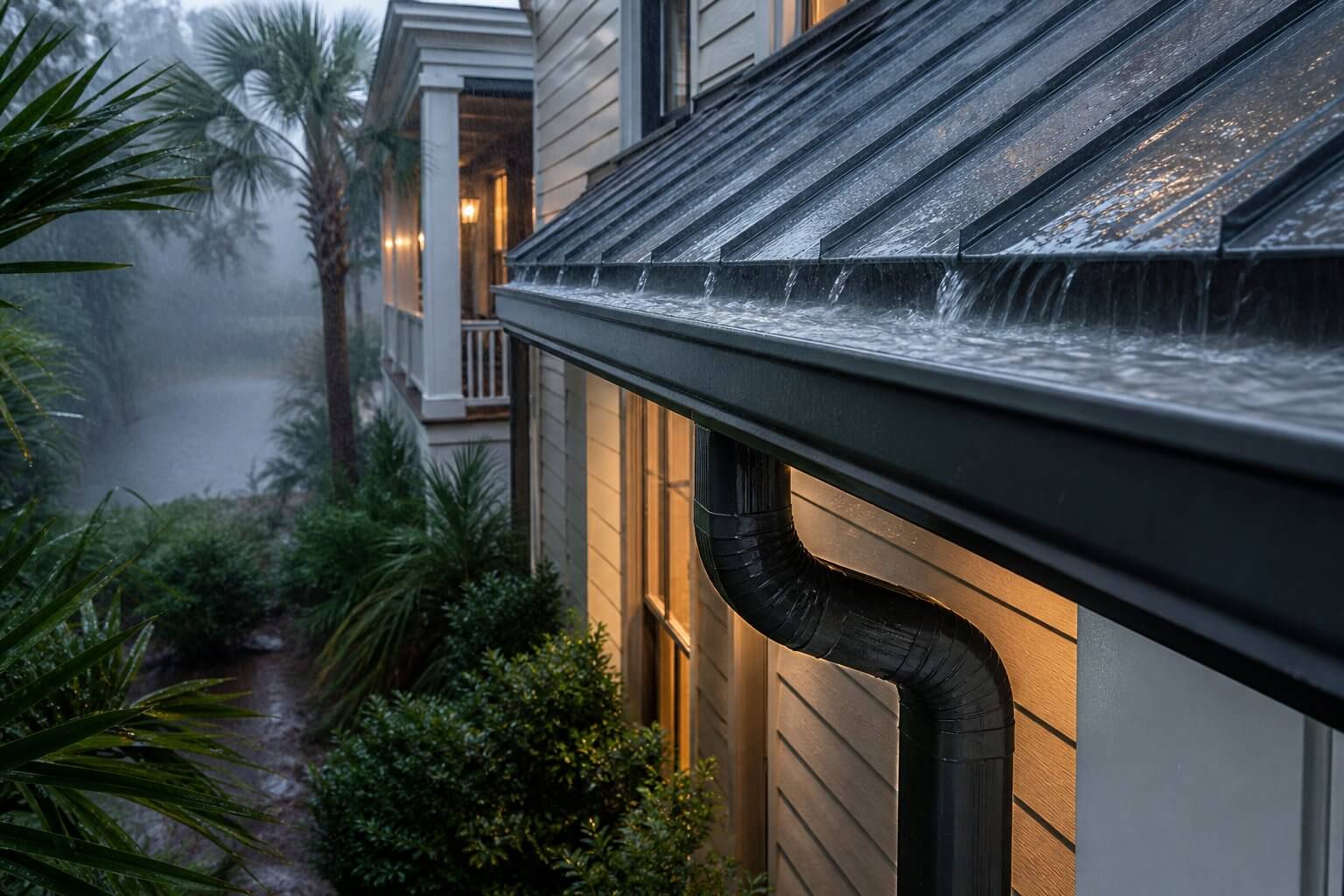
Key Points:
- Volume Matters: Builder-grade 5-inch gutters work fine in a drizzle, but intense Lowcountry cloudbursts quickly overwhelm smaller troughs.
- The 50% Capacity Jump: Stepping up to 6-inch gutters increases water volume capacity by roughly 50%, stopping high-velocity overshooting in its tracks.
- Roof Dynamics: Steep architectural pitches, expansive roof planes, and smooth materials like metal shed water fast, requiring a wider catch basin.
- Protecting Hardscapes: High-capacity gutters eliminate splash-back erosion that washes away flowerbeds and undermines foundation soil.
- Proportional Aesthetics: Modern 6-inch K-style aluminum gutters fit standard residential trim neatly without looking bulky or commercial.
If you’ve spent even one summer in coastal South Carolina, you know the exact moment a storm turns. The sky drops into a deep slate gray, the air cools off fast, and within thirty seconds, it feels like someone turned a firehose straight onto your shingles.
Next time one of those afternoon cloudbursts hits, take a quick peek out your front window. Are your gutters quietly channeling that deluge toward the yard, or are they overflowing like mini white-water rapids over your front steps?
For decades, standard 5-inch gutters were the default choice for homebuilders across Charleston, Summerville, and Mount Pleasant. They handle a light spring drizzle without issue. But as local storm patterns bring sharper, higher-volume downpours, a lot of homeowners are discovering their gutters aren't actually broken—they're just undersized for the job. Evaluating 5 vs 6 inch gutters for your Charleston, SC home isn't about buying a fancier feature; it’s about making sure your home's drainage can keep up with the sheer volume of water coming off your roof.
Why do standard 5-inch gutters struggle during heavy Lowcountry rainstorms?
To see why smaller gutters fail, it helps to look at how water behaves when it hits a roofline during a coastal storm. According to precipitation data from the National Weather Service, coastal South Carolina routinely sees short, intense storms that drop an inch or more of rain in under twenty minutes.
A standard 5-inch K-style gutter has a five-inch top opening and a narrow bottom channel. During a normal light rain, gravity carries the runoff toward the downspouts without a hitch. But when a sudden tropical downpour rolls through, the sheer volume of water rushing off your shingles overwhelms the speed at which that 5-inch channel can drain.
What causes gutters to overshoot in heavy rain?
Gutter overshooting occurs when the volume and velocity of roof runoff exceed a trough's drainage capacity. In standard 5-inch gutters, incoming rainwater hits the standing water already trapped inside the narrow channel, hydroplaning straight over the front lip instead of flowing down the downspout.
When a smaller gutter fills to the brim, incoming water hits the standing pool inside the trough and hydroplanes right over the front lip. Contractors call this overshooting. The water never even reaches your downspouts—instead, it cascades straight down onto your flowerbeds, walkways, and foundation.
How much more water can a 6-inch gutter actually handle?
It’s easy to assume that adding just one inch to a gutter's width gives you a tiny 20% performance boost. But because a gutter is a three-dimensional trough, that extra inch expands both the top catch area and the total depth.
- 5-Inch Gutters: Hold roughly 1.2 gallons of water per linear foot.
- 6-Inch Gutters: Hold roughly 2.0 gallons of water per linear foot.
That single inch across the top translates to an overall capacity increase of roughly 50%. That extra space acts as a vital buffer during sudden cloudbursts. Instead of spilling over immediately, a 6-inch gutter holds the sudden surge, giving the runoff time to channel smoothly into high-capacity downspouts.
What are the 5 telltale signs my home needs an upgrade to 6-inch gutters?
If you aren't sure whether your current system is undersized, keep an eye out for these five warning signs around your property.
1. Water Is Overshooting the Front Lip During Heavy Rain
If you look out during a storm and see continuous sheets of water leaping over the front edge—even though your gutters are completely clean of leaves and pine needles—your system is simply being overwhelmed by water volume.
2. You Have Large Roof Planes, Steep Pitches, or Complex Valleys
The steeper your roof, the faster gravity pulls water down toward the edges. When two large roof slopes meet at a valley (a common feature in multi-story homes in Mount Pleasant and James Island), hundreds of square feet of runoff funnel straight into one spot. A 5-inch gutter doesn't have a wide enough opening to catch that high-velocity stream.
3. You See Deep Soil Erosion Trenches Beneath Your Roofline
Take a walk around your perimeter after the rain stops. If you spot deep grooves carved into your mulch, exposed plant roots, or mud splattered high onto your siding, water is falling directly from your roof edge rather than traveling down your downspouts. If this runoff pools against your foundation walls, it can lead to severe crawlspace moisture and mold issues.
4. Your Gutters Constantly Sag or Pull Away from the Fascia
Water is heavy—weighing over 8 pounds per gallon. When a 5-inch gutter fills up and drains too slowly, that sudden trapped weight puts massive stress on the brackets. Over time, that weight pulls fasteners loose from damp fascia boards. If you notice sagging, our local gutter repair service can re-pitch your system or replace damaged wood before hanging stronger brackets.
5. Your Home Features Smooth Roofing Materials (Metal or Tile)
Materials like standing-seam metal or synthetic tile have slick surfaces with zero friction. Unlike asphalt shingles, which slow down water flow slightly, smooth roofs shed water at incredible speeds—making the wider catch area of a 6-inch trough practically essential. To keep these wide channels free of debris, pairing them with micro-mesh gutter filtration guards keeps fine pine needles out without slowing down water entry.
Will 6-inch gutters look too bulky on my home's exterior?
A lot of homeowners worry that stepping up to a 6-inch system will make their house look like a commercial warehouse.
In reality, residential 6-inch K-style gutters feature a classic crown-molding profile that scales neatly against standard 6-inch fascia boards and modern trim lines. Because seamless aluminum systems are custom-formed on-site and color-matched to your trim or fascia, the extra inch blends right into the architecture. Most homeowners find that 6-inch gutters actually give their roofline a cleaner, more balanced look.
Scenario A: The Expansive Suburban Roof in Mount Pleasant
A homeowner in Mount Pleasant had a spacious two-story home with expansive shingle roof planes. During summer storms, the 5-inch builder-grade gutters over the front entry constantly overflowed, washing away expensive landscaping mulch and creating a messy splash zone across the front porch steps.
Upgrading the front elevation to a custom seamless 6-inch aluminum gutter—paired with oversized 3x4-inch downspouts—captured 100% of the valley runoff. The mulch stayed put, and the entryway stayed dry.
Scenario B: The Steep Metal Roof in Summerville
A custom home in Summerville featured a steep-pitched metal roof over the main living area. Rainwater accelerated off the slick metal surface so fast that it hydroplaned right across the top of the existing 5-inch gutters, dumping water directly against the foundation wall.
By replacing those undersized troughs with high-capacity 6-inch seamless gutters held by heavy-duty hidden hangers, the wider opening caught the fast-moving stream effortlessly. You can read more real-world experiences from local neighbors on our customer reviews page.
Expert Tips from a Local Contractor
- Perform the "Rain Check": During the next solid thunderstorm, grab an umbrella and step outside to inspect your roof valleys. If you see water leaping clear over the gutter edge at those convergence points, that specific section needs 6-inch capacity.
- Always Upgrade Your Downspouts Too: A 6-inch gutter is only as good as its exit route. Always pair 6-inch troughs with oversized 3x4-inch downspouts rather than standard 2x3-inch outlets to avoid bottlenecking.
- Space Hangers Tightly: Because 6-inch gutters hold 50% more water weight during peak flow, insist on commercial-grade screw-in hidden hangers spaced no more than 24 inches apart.
- Match Architectural Style: If you have a historic home in Downtown Charleston or a custom build on Kiawah Island, consider half-round 6-inch gutters as an architectural alternative to standard K-style troughs.
Conclusion
When coastal storms test your home's exterior, the capacity of your gutter system matters just as much as its maintenance. While standard 5-inch gutters work fine under average conditions, modern Lowcountry weather patterns, steep rooflines, and complex architectural designs often demand a high-capacity solution.
Recognizing when your home needs an upgrade from 5-inch to 6-inch gutters is a practical step toward protecting your foundation, flowerbeds, and fascia boards from costly water damage. Learn more about our local team and values to see how we help Charleston homeowners safeguard their properties.
Not Sure If Your Home Needs 5-Inch or 6-Inch Gutters? Let’s Take an Honest Look.
Unsure if your current gutters are undersized or just need a simple pitch adjustment? Standard Gutter is here to help homeowners across Charleston, Summerville, Mount Pleasant, West Ashley, Johns Island, and surrounding Lowcountry communities.
We offer straightforward evaluations, clear answers, and practical custom seamless gutter installation options tailored to your home—without high-pressure sales tactics.
Call Standard Gutter today or visit us online to request your free, no-obligation roofline assessment.
Frequently Asked Questions
Are 6-inch gutters significantly more expensive than 5-inch gutters?
The price difference between 5-inch and 6-inch seamless aluminum gutters is relatively modest—typically only a few dollars more per linear foot for materials. Given that 6-inch systems provide 50% more volume capacity and help prevent costly foundation and landscaping repairs, most homeowners find the upgrade offers a much higher return on investment.
Can I install 6-inch gutters using my existing 2x3-inch downspouts?
While it is technically possible to funnel a 6-inch gutter into a standard downspout, it isn't recommended. Smaller 2x3-inch downspouts create a bottleneck that restricts water flow, largely defeating the purpose of installing a high-capacity trough.
Do 6-inch gutters require stronger mounting hardware?
Yes. Because 6-inch gutters carry significantly more water weight during intense downpours, professional installers use heavy-duty, internal screw-in hidden hangers rather than old-style spikes or light brackets.
How do I know if my roof square footage requires 6-inch gutters?
As a general rule, if a single continuous roof plane feeding into a gutter run exceeds 600 to 800 square feet—or if your roof has a steep pitch—a 6-inch gutter system is recommended to handle peak rainfall volume.
Will upgrading to 6-inch gutters ruin my home's curb appeal?
Not at all. Residential 6-inch K-style gutters are designed with a sleek, decorative profile that mimics residential crown molding. When custom color-matched to your fascia or trim, they blend seamlessly into your home's exterior.
Do standing-seam metal roofs always require 6-inch gutters?
In almost all cases, yes. Metal roofs shed water much faster than asphalt shingles because there is no surface friction to slow down the flow, making the wider opening of a 6-inch gutter necessary to catch fast-moving water.
Can 6-inch gutters help prevent soil erosion around my foundation?
Absolutely. By capturing 100% of heavy roof runoff and directing it safely away through downspouts, 6-inch gutters eliminate the aggressive water streams that dig erosion trenches and wash away topsoil near foundation walls.
Are 6-inch gutters easier or harder to keep clean?
6-inch gutters are actually slightly easier to clean by hand because the wider 6-inch opening provides more room for your hands. Furthermore, their wider trough integrates seamlessly with high-performance micro-mesh gutter guards.
Can I install 6-inch gutters on just part of my home?
Yes. Many homeowners choose to install high-capacity 6-inch gutters on steep back rooflines or beneath major roof valleys, while keeping standard sizing on short, straightforward runs like porch overhangs.
How long does it take to replace old 5-inch gutters with a new 6-inch system?
A professional crew equipped with a custom seamless gutter machine can typically remove your old 5-inch system, inspect the fascia boards, and fabricate and install a complete 6-inch seamless aluminum system in a single day for most standard residential homes.