
Key Points:
- The Root Cause: Thousands of gallons of rainfall pouring off a Charleston roofline pool against foundation walls, saturating surrounding soil and migrating straight under your home.
- The Stack Effect: Moisture trapped beneath your floors doesn't stay there—it rises into living spaces, raising indoor humidity and triggering mold growth.
- Lowcountry Soil Dynamics: Sandy topsoils resting over dense clay catch standing water right at the surface near raised piers and brick foundations.
- Practical Solutions: Upgrading to high-capacity 6-inch seamless gutters with extended downspouts or underground pop-up drains keeps roof runoff far away from your foundation perimeter.
- Educational Approach: Addressing water drainage outside is the critical, cost-effective first step before pursuing expensive internal repairs or crawlspace encapsulation.
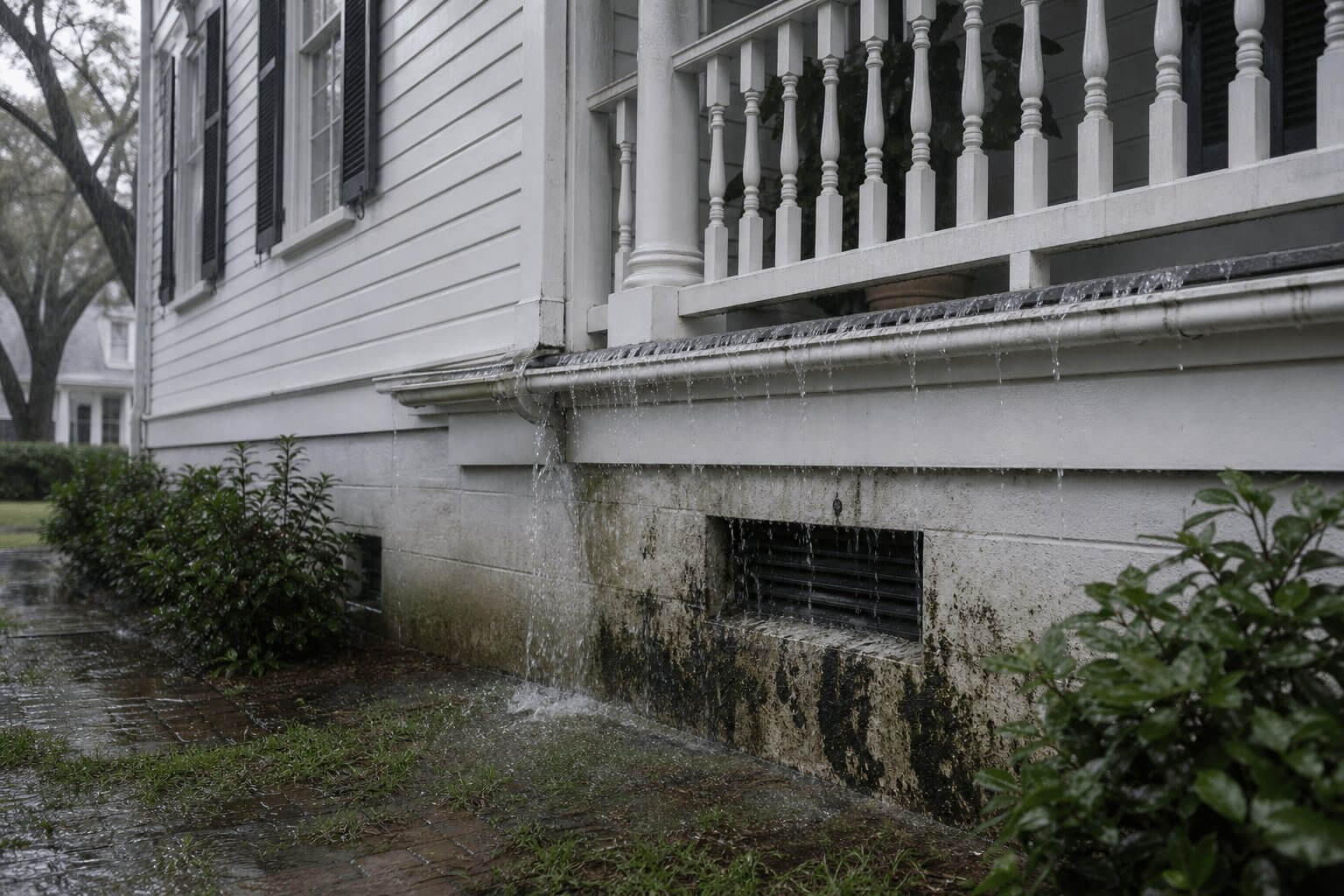
Picture a typical Lowcountry summer afternoon. The sky opens up without warning, dumping two inches of warm, tropical rain in under an hour. You're inside enjoying the AC, but right outside your window, a miniature waterfall is pounding the dirt along your home's foundation line.
To most of us, that sheet of water looks like an annoyance for the flowerbeds—maybe something that'll wash away a little mulch. But down under your floorboards, in the dark, cramped space beneath your feet, that pooling water is setting off a silent chain reaction.
If you live in coastal South Carolina, damp crawlspaces are practically a rite of passage. But while ambient humidity down here is unavoidable, a soaking-wet crawlspace isn't something you just have to live with. More often than not, the real culprit isn't sitting under your house at all—it's hanging right above your head. Stopping moisture under your living room doesn't require pushy contractors or complicated overhauls. It starts with understanding how water moves off your roof when the sky falls.
Why is water building up around my foundation in the first place?
During a routine Lowcountry storm, a standard 2,000-square-foot roof catches a massive amount of water—roughly 1,200 gallons during a single heavy rain event. When an intense cloudburst hits, that entire volume comes rushing down in a matter of minutes. Without a properly designed custom seamless gutter installation to catch and carry that deluge, all those gallons dump into a narrow three-foot strip right against your home's exterior walls.
Our local dirt makes matters worse. According to guidance from the Clemson University Cooperative Extension Service, across Greater Charleston, a thin layer of sandy topsoil usually rests on top of dense, stubborn clay. That sandy soil drinks up the first few minutes of rain quickly enough, but once it hits the clay line beneath, the water stops dead.
When heavy mulch beds sit right up against your siding, they act like a sponge, holding that trapped water against your foundation walls. Hydrostatic pressure builds up until the water finds the easiest path forward—which happens to be right under your house.
How does rain on my roof end up as humidity and mold in my crawlspace?
In coastal homes, the "Stack Effect" turns your living space into a natural vacuum. Think of your home like a chimney: as warm air naturally rises and vents through the attic, it pulls replacement air straight up out of your crawlspace.
When rainwater pools around your foundation piers, two distinct problems take over:
- Capillary Action: Moisture wicks horizontally through porous brick, concrete block, and dirt. It creeps right past the edges of plastic vapor barriers, which are designed to block ground vapor, not standing liquid pooling along the edges.
- Evaporation: Once that standing water settles in the dark, enclosed space underneath your joists, it turns into pure water vapor.
Keep relative humidity above 60% in a warm, dark space like that—a critical threshold highlighted by the U.S. Environmental Protection Agency for mold prevention—and you've accidentally built a luxury resort for wood-destroying fungi. Worse yet, because of the Stack Effect, the air you breathe in your kitchen and bedrooms is being pulled directly from that damp environment downstairs—bringing musty smells, sticky air, and airborne spores right along with it.
What are the early warning signs that gutter runoff is damaging my home underneath?
Spotting drainage issues early can save you tens of thousands of dollars in structural repairs down the road. You don't always have to crawl under the house with a flashlight to figure out what's happening.
Inside Your Home:
- Cupping Hardwood Floors: The edges of your floorboards rise higher than the centers, caused by heavy moisture pushing up from below.
- Musty AC Vents: A distinct, earthy odor catches your attention whenever the air conditioning kicks on.
- Sticking Doors: Interior doors that swung freely in November suddenly rub or jam against their frames during humid summer months.
- Clammy Indoor Air: Spikes in indoor humidity make your home feel sticky, even when the AC runs constantly.
Outside Your Home:
- Erosion Trenches: Noticeable grooves or washouts carved into mulch and dirt directly beneath the roofline.
- Mud-Splattered Siding: Dirt and soil blasted several inches up your exterior walls after a storm.
- Tide Marks on Brick: Dark, damp water lines lingering on your brick foundation long after the sun comes back out.
- Green Algae Creep: Moss or algae taking hold near the base of your foundation walls where ground moisture stays trapped.
If you're noticing these warning signs around your property, your roofline drainage is almost always the first place you should investigate.
Why aren’t my current gutters protecting my crawlspace?
Plenty of Lowcountry homes already have gutters, yet their crawlspaces are still soaking wet. As it turns out, a failing or undersized system can actually concentrate water damage worse than having no gutters at all. If you notice leaks along your roofline, a targeted gutter repair service can often fix joint failures before structural damage spreads.
- Undersized 5-Inch Troughs: Standard 5-inch gutters were fine years ago, but they simply get overwhelmed by modern coastal downpours. When a trough chokes on volume, water spills back over the rear edge, running down your fascia board.
- Fascia Board Rot: When water continuously spills over the back of an undersized or clogged gutter, it wicks directly into the wood fascia behind it. As that fascia rots, hanger screws lose their grip, causing the entire gutter to lose its pitch. This guarantees massive, uncontrolled spillover right at your foundation.
- The Pine Needle Problem: Loblolly pine needles and spring oak tassels love to weave tightly woven mats inside gutter troughs. Installing micro-mesh gutter filtration guards prevents these debris dams from forcing rainwater to sheet over the front like a spillway.
- Short Downspouts: A downspout that dumps water directly at the corner of your house takes massive volumes of roof runoff and concentrates them into one single, high-risk spot.
How do custom seamless gutters solve crawlspace moisture problems?
Solving crawlspace water issues comes down to one simple goal: catch the rain at the roofline and move it well away from your foundation before it ever touches the soil. Per structural standards outlined by the U.S. Department of Housing and Urban Development, redirecting surface water away from foundation walls is the single most effective defense against foundation damage.
- Step Up to 6-Inch Systems: Upgrading to high-capacity 6-inch seamless aluminum gutters gives you roughly 50% more water volume capacity than standard 5-inch troughs. That extra size makes all the difference when a summer storm drops an inch of rain in fifteen minutes.
- Build Seamless On-Site: Sectional gutters bought off the shelf at hardware stores have joints every ten feet. Down here, intense sun and humidity expand and contract those joints until they leak. Custom seamless gutters are formed right in your driveway to fit your home's exact lengths—no middle seams, no middle leaks.
- Anchor with Heavy-Duty Screws: Instead of relying on old-style spikes that pull free from damp fascia boards over time, commercial-grade hidden hangers secured with heavy-duty screws keep the pitch intact and hold firm against high coastal winds.
- Extend the Discharge (Including Narrow-Lot Solutions): Extending downspout outlets 3 to 5 feet past the foundation wall keeps runoff away from your perimeter. For homes on tight lots or close subdivisions in Mount Pleasant or Downtown Charleston where surface pipes would cross walkways, subterranean discharge lines connected to underground pop-up emitters safely carry water out to the street or lawn swale.
Scenario A: The Historic West Ashley Ranch
A homeowner in an established West Ashley neighborhood started noticing her original oak floors cupping down the hallway. A quick check underneath revealed crawlspace humidity soaring above 85%. The home was fitted with short, older sectional gutters that dumped downspouts right next to the brick support piers.
After replacing the worn-out system with custom 6-inch seamless gutters and extending the downspouts four feet away from the foundation, water stopped pooling at the piers entirely. Within a few weeks of dry ground around the perimeter, the humidity under the house dropped back into a safe zone. You can read how fellow neighbors handle similar drainage projects.
Scenario B: New Construction in Summerville
A family in a newer Summerville subdivision had a steep roof valley that funneled massive streams of water directly onto a flowerbed right beside their crawlspace access door. Every time an afternoon thunderstorm rolled through, water pooled against the hatch and seeped inside.
By installing a custom-pitched seamless gutter with targeted rain diverters, the roof valley runoff was captured and redirected around the garage corner. The simple fix preserved both their fresh landscaping and their crawlspace interior.
Expert Tips from a Local Contractor
- Try the "Umbrella Test": Next time a solid rain hits, throw on a rain jacket, grab an umbrella, and walk your home's perimeter. Look up at the roofline to see if water is overtopping the troughs or leaking behind the fascia. Then look down to see where that water lands.
- Watch Where Downspouts Point: Double-check that your downspout elbows aren't discharging water onto soil that slopes right back toward the house. Water always follows gravity; make sure gravity is working in your favor.
- Keep an Eye on Soil Grade: Gutters do the heavy lifting, but your dirt needs to help out too. The ground around your foundation should slope downward at least 6 inches over the first 10 feet away from your home.
- Clear Your Outlets: Make a habit of checking downspout outlets twice a year. Fine Loblolly pine needles like to collect in lower elbows, creating quiet blockages that back water up into your roofline.
Proper maintenance is key to maximizing the life of your 4-year workmanship warranty.
Conclusion
Protecting your Charleston home from humidity, mold, and foundation stress doesn't always require expensive structural overhauls. More often than not, the solution starts right at your roofline. By catching rainwater as it falls and guiding it safely away from your foundation walls, custom seamless gutters give your home a practical, long-term defense against Lowcountry weather.
Taking care of your property should feel straightforward and manageable, not overwhelming. Learn more about our team's local approach to helping homeowners protect their primary investments across the Charleston area.
Protect Your Foundation with an Honest, Local Roofline Assessment
Concerned about standing water or dampness around your home's foundation? Standard Gutter is here to help homeowners across Charleston, Summerville, Mount Pleasant, West Ashley, Johns Island, and surrounding Lowcountry communities.
We provide straightforward evaluations, clear answers, and practical, seamless gutter solutions tailored specifically to your home—without high-pressure sales tactics.
Call Standard Gutter today or visit us to request your free, no-obligation estimate.